 |
| Take a shower http://www.flickr.com/photos/matthijs/ CC BY-NC-ND 2.0 |
This is World Water Week, and this post is a confession, a bit of a rant, and an appeal to care about the importance of water in our lives.
I confess. I am a water hog. I like clean. Clean body. Clean clothes. Clean dishes. Clean food. When I'm in the shower, I revel in the warm cascade of water sliding over my face, running down my back. In the kitchen, I’d rather wash the dishes than dry, my hands plunged deep into the tub of glistening suds. When I was younger, I learned to swim one summer just so I could feel what it is like to lie suspended in a quiet lake.
Yes, occasionally then, on a weekday morning, high in the mountains, it was possible to have a quiet hour or two in the lake. If the lake was fed by hot springs, the water and surrounding forest-covered hills felt deliciously womb-like.
Water bottle, check, but what else should we be doing?
I am slowly growing a consciousness about the need to conserve water. Sure, I carry a refillable water bottle and turn off the tap when I brush my teeth and between rinsing the dishes. Been doing that for years. But there is a lot I don't do. When I wash fruit and vegetables, I wash them thoroughly under full running water. I want the force of the water to purge any lurking e-coli and salmonella strains from the fresh goodies I am about to feed my family. They don't get sick if produce is not thoroughly washed, but I do. Frequently. So much so that I rarely take salad in restaurants or pot luck. It's simply not worth a day or two of what I euphemistically refer to as dysentery. So when I learned this week is World Water Week, I almost wanted to ignore it.
There are so many reasons not to.
Chief among them, knowing how ill I get when fruit isn't thoroughly washed, how can I ignore the fact that fully one-sixth of the world's population--that's roughly one billion people--have no clean drinking water source. None. Every minute, four children die because of water-borne illness. Every minute. So what, you say?
How can anything we do here in water-rich America affect the dying children in so many other parts of the world? Turns out, we are a big part of the cause of their short water supply.
We’re a big part of the problem and we need to fix that
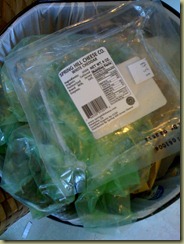 |
| My kitchen trash today © L. Kathryn Grace |
Yep. Once again, the onus is on us. And you know, the reason it is on us is that everything is connected. We want so darn much stuff. We consume--and throw away--so much food, sweetened beverages in plastic bottles, electronics, plastic toys in plastic-wrapped packages, shampoo bottles, shower-gel bottles, lotion tubes, much of it manufactured, bottled and shipped overseas. Take a look at your garbage can and recycling bins. What are you throwing away every day, every week?
Water is used to manufacture every one of those things, including processing the food we eat. Even if we eat mostly organic, locally grown, whole foods, we expect them to be clean, free of dirt and bugs, when we place them in our shopping basket. We love clean. I admit, I probably love it more than others, but we Americans love clean.
There’s more. Apparently, we tend to be rampant thieves. Almost everything we buy is heavily packaged. Shrink-wrapped, tied down, encased in plastic and cardboard that weigh three times or more than the doo-dad itself, our toys and household goods come in nearly impenetrable packages. All that paper, cardboard and plastic, again most of it manufactured overseas, requires enormous quantities of water to produce.
Polluting and draining their rivers and aquifers for a buck—our bucks
Whether they're growing rice for our pantries and restaurants, bottling their tap water to slake our thirst for portable, potable, nipple-topped water jugs, or polluting and draining their rivers and aquifers to make cheap cell phones, video game consoles and handbags, the countries whose near slave-labor assures we have the latest gadgets and the most stylish embroidered jeans are turning their forested lands to deserts. For us. For a buck. For lots of bucks.
In India, in China, in Indonesia, in Central America, wherever land and water are more valuable as resources to feed Western appetites, children are dying because they cannot get access to fresh, clean, sparkling, pure water.
It's not too far a stretch to say that we, with our insatiable desire for the cheap gadget, the quick fix, the most convenient drive-by stop-and-shop with its grab-and-go packaged goods, the latest sunglasses, and the hippest, newest MP3 player (in my case, the iPad, erk) are killing the world's children. As ordinary as that is, there's nothing Ordinary about it.
That's why we should care that this is Water Week.
How can we change? What new steps should we take?
So I ask you: How can we change our ways? What steps can you and I take to lessen the impact of water shortages on the people manufacturing our trendy, yummy and kitschy goods? How are you mindful of the ways in which your choices impact lives overseas? What are you already doing to conserve water and prepare for a water-wise world?


 (2010)