Imagine the world without anger, without greed. We have the power, the tools, the skills and the resources right now to build a peaceful world, where people live in harmony with the Earth and each other. This blog explores ways we are doing just that, one post, one change, one day at a time. Join me. Tell your stories. Ask for help. Spread your ideas for making the vision real and, well, ordinary.
Showing posts with label water. Show all posts

Sunday, September 5, 2010

What is Water Week and why should we care?

Take a shower
http://www.flickr.com/photos/matthijs/
CC BY-NC-ND 2.0

This is World Water Week, and this post is a confession, a bit of a rant, and an appeal to care about the importance of water in our lives.

I confess. I am a water hog. I like clean. Clean body. Clean clothes. Clean dishes. Clean food. When I'm in the shower, I revel in the warm cascade of water sliding over my face, running down my back. In the kitchen, I’d rather wash the dishes than dry, my hands plunged deep into the tub of glistening suds. When I was younger, I learned to swim one summer just so I could feel what it is like to lie suspended in a quiet lake.

Yes, occasionally then, on a weekday morning, high in the mountains, it was possible to have a quiet hour or two in the lake. If the lake was fed by hot springs, the water and surrounding forest-covered hills felt deliciously womb-like.

Water bottle, check, but what else should we be doing?

I am slowly growing a consciousness about the need to conserve water. Sure, I carry a refillable water bottle and turn off the tap when I brush my teeth and between rinsing the dishes. Been doing that for years. But there is a lot I don't do. When I wash fruit and vegetables, I wash them thoroughly under full running water. I want the force of the water to purge any lurking e-coli and salmonella strains from the fresh goodies I am about to feed my family. They don't get sick if produce is not thoroughly washed, but I do. Frequently. So much so that I rarely take salad in restaurants or pot luck. It's simply not worth a day or two of what I euphemistically refer to as dysentery. So when I learned this week is World Water Week, I almost wanted to ignore it.

There are so many reasons not to.

Chief among them, knowing how ill I get when fruit isn't thoroughly washed, how can I ignore the fact that fully one-sixth of the world's population--that's roughly one billion people--have no clean drinking water source. None. Every minute, four children die because of water-borne illness. Every minute. So what, you say?

How can anything we do here in water-rich America affect the dying children in so many other parts of the world? Turns out, we are a big part of the cause of their short water supply.

We’re a big part of the problem and we need to fix that
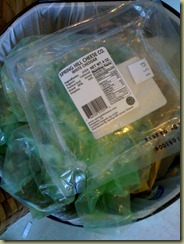
MyKitchenTrash_09-08-10
My kitchen trash today
© L. Kathryn Grace

Yep. Once again, the onus is on us. And you know, the reason it is on us is that everything is connected. We want so darn much stuff. We consume--and throw away--so much food, sweetened beverages in plastic bottles, electronics, plastic toys in plastic-wrapped packages, shampoo bottles, shower-gel bottles, lotion tubes, much of it manufactured, bottled and shipped overseas. Take a look at your garbage can and recycling bins. What are you throwing away every day, every week?

Water is used to manufacture every one of those things, including processing the food we eat. Even if we eat mostly organic, locally grown, whole foods, we expect them to be clean, free of dirt and bugs, when we place them in our shopping basket. We love clean. I admit, I probably love it more than others, but we Americans love clean.

There’s more. Apparently, we tend to be rampant thieves. Almost everything we buy is heavily packaged. Shrink-wrapped, tied down, encased in plastic and cardboard that weigh three times or more than the doo-dad itself, our toys and household goods come in nearly impenetrable packages. All that paper, cardboard and plastic, again most of it manufactured overseas, requires enormous quantities of water to produce.

Polluting and draining their rivers and aquifers for a buck—our bucks

Whether they're growing rice for our pantries and restaurants, bottling their tap water to slake our thirst for portable, potable, nipple-topped water jugs, or polluting and draining their rivers and aquifers to make cheap cell phones, video game consoles and handbags, the countries whose near slave-labor assures we have the latest gadgets and the most stylish embroidered jeans are turning their forested lands to deserts. For us. For a buck. For lots of bucks.

In India, in China, in Indonesia, in Central America, wherever land and water are more valuable as resources to feed Western appetites, children are dying because they cannot get access to fresh, clean, sparkling, pure water.

It's not too far a stretch to say that we, with our insatiable desire for the cheap gadget, the quick fix, the most convenient drive-by stop-and-shop with its grab-and-go packaged goods, the latest sunglasses, and the hippest, newest MP3 player (in my case, the iPad, erk) are killing the world's children. As ordinary as that is, there's nothing Ordinary about it.

That's why we should care that this is .

How can we change? What new steps should we take?

So I ask you: How can we change our ways? What steps can you and I take to lessen the impact of water shortages on the people manufacturing our trendy, yummy and kitschy goods? How are you mindful of the ways in which your choices impact lives overseas? What are you already doing to conserve water and prepare for a water-wise world?

__
 
We make peace in a million small ways every day.
All text and images, unless otherwise noted, copyright L. Kathryn Grace. All rights reserved.
Enhanced by Zemanta

Wednesday, May 19, 2010

Did you shower today?

Lucky you. Lucky me. We can shower every day. Wash our clothes. Take a drink any time we want.
For now.

According to the New York Times, our easy access to water may soon be a luxury.

Thirty-six states face water shortages in just three short years. California knows all about water shortages. We've been getting some of our water from other states for decades. Farmers in the Central Valley, where much of the nation's food is grown, are going out of business, unable to get water to their crops.
California is not the only U.S. state with water supply issues. By 2013, at least 36 states expect shortages, according to a 2003 study by the U.S. Government Accountability Office.
Take a look at the world map on the water crisis page of the World Water Council. See all that red and brown on the United States? That means we're using water faster than the earth can replenish. Much faster. In fact, only a small portion of the United States is safe from running out of water.

#WaterWednesday

That's why I participate in #WaterWednesday on Twitter. Every Wednesday, mindful Tweeps (people who tweet on Twitter) from all walks of life take time to learn a little more about the world water crisis and pass along what we learn.

We give each other tips on conserving water at home and work, participate in calls to action, write our senators and congressional representatives, blog about water rights and needs, and lend a helping hand any way we can. We try to have fun while we're focusing on water issues, and we're prepared for the heartbreaking stories (slide show) that bring the reality of the world's dwindling fresh water supply home. This brief video does a little of both.


New oil, blue gold and water wars

We don't hear about water wars every day, but they're happening--here at home between states, between cities and agriculture, bloodier ones abroad.

Some say water is the new oil. Global climate change is drying up the glaciers that feed our rivers and streams. Desertification caused by deforestation and agriculture exacerbates nature-caused droughts on every continent. Scarcity breeds greed. Greed breeds ever smaller circles of ownership and control over water resources. You know about the oil cartels. There is talk of water cartels.

Water is so valuable, as Wall Street tightens its grip on the world's shrinking water supply, that some are dubbing it blue gold. So important is water that, little known to you and me, Congress holds hearings on it frequently. You can bet that big corporations, with their multi-million dollar lobbyists, are making sure they get the deepest wells, the tallest fountains, and the biggest pipes.

Get a glimpse of what I'm talking about here.


If we are to build the world of Ordinary, we must take notice of the world of water now.

Do you love your shower?

Do you love your shower in the morning? You and I may be dead by the time the tap stops flowing in our country, but chances are good we'll see water rationing, including the taps in our homes, in the next decade. It's time to get involved. The question is, how?

I'd like to hear from you. Have you studied this issue? Are you concerned about your water rights now? Down the road? Who do you think should own water? Where do you think we, ordinary citizens, should start in terms of informing ourselves and taking action?
__
We make peace in a million small ways every day.
All text and images, unless otherwise noted, copyright L. Kathryn Grace. All rights reserved.

Wednesday, May 5, 2010

44 pounds, 80 minutes

Are you planning to watch TV tonight? I encourage you to spend 80 minutes watching 44 pounds instead. It's hauntingly beautiful, sweetly silent, save for muted voices, the occasional footfall on rock. If you don't have 80 minutes to spare, watch the 2-minute time-lapse version. Viewing it was enough to make me want to see the whole thing. Afterward, please take time to tell me what you learned, what you felt, how you might respond.


44 Pounds from water.org on Vimeo.


44 Pounds, 2 Times a day

Berhane makes this trek twice a day, every single day. Imagine hauling water this way when you are sick with the stomach flu, or your children, whom you must leave at home, have chicken pox.

How did you feel when you saw that young woman climbing down into the well, clinging to the wall, and lifting out the jerry can to her friend? What do you think would have happened if the second well had been too dirty, like the first?


Give water, Save lives

Nearly one billion people lack access to safe water and 2.5 billion do not have improved sanitation. The health and economic impacts are staggering.

Every minute, four children die because of water-borne illness. Every minute. Organizations like water.org and Water Charity, are working hard and fast to help villagers in Ethiopia, India, Haiti and many other countries dig wells, install pumps. They show parents how to save their children's lives by using some of their precious fuel to boil water.

Can you help? Will you spread the word through your blog, Facebook, or Twitter? It takes only a moment if you use the buttons immediately below this post. If you have a little extra cash, will you take time to donate? Both sites linked to above have easy to use donate buttons on their home pages.


Why it matters

Apart from the sheer humanitarian need to help when we learn of another's distress and have the means to be of use, why should we care so much about water?

We in the developed West are fortunate to have all the water we need--for now. According to many scientists, the world is in a planet-wide water crisis that may result in water wars sooner than any of us imagine. Very likely you and I will live long enough to experience the first wave of these. Crazy as it sounds today, our children and grandchildren may face much worse.

For now, we are the lucky ones. Beginning to know and understand the problem is an important first step. Lending a hand to the real people already experiencing the crisis is an equally important second step.

What can you do to help the one-sixth of the world's children who do not have safe, clean water to drink? Can you help save a few lives today? Will you help spread the word? Spare a few dollars? It's the Ordinary thing to do.

__
 
We make peace in a million small ways every day.
All text and images, unless otherwise noted, copyright L. Kathryn Grace. All rights reserved.

Enhanced by Zemanta

Thursday, April 1, 2010

We use (almost) enough bottled water to fill the Rose Bowl every day

Yesterday, in Would you pay $10,000 for a sandwich?, we discovered just how costly those handy bottles of water we suck on throughout the day really are.

Not only do we pay 2000 times the cost of tap water, or about $8/gallon when we buy a 16 ounce bottle, we also make a really big mess. Tons of our bottles clutter our parks and streets and gutters. Eventually they flow into our rivers and oceans, where they kill wildlife. Megatons more go directly to the landfill. Only about a third are recycled. But whoa, Annie Leonard, in her video, The Story of Bottled Water, showed us that even those recycled bottles turn up in China and India, where we ship them to get them out of our hair. There, mountains of plastic bottles, a fraction of which are recycled into new plastic kitsch, clutter the landscape, unusable.

What Leonard didn't mention is how much H2O it takes to make that bottle of water we guzzle and pitch. That's where Pasadena and the Rose bowl come in. Here's the quick and dirty.

According to Brian Merchant on TreeHugger last year, manufacturers use almost 2 gallons (1.85 to be exact) to make a single plastic water bottle. That doesn't count the 16 ounces of water we actually drink. Considering that every second of every day, 1,000 people open a bottle of water in the United States, that comes to 1850 gallons a second, or 159,840,000 gallons every 24 hours. That's enough to supply the thirsty City of Pasadena five times and almost enough to fill up the Rose Bowl. (You'll need to scroll down quite a ways to find their blurbs on that link, but they're there.)

Every second of every day in the United States, a thousand people buy and open up a plastic bottle of commercially produced water, and every second of every day in the United States, a thousand plastic bottles are thrown away. Eighty-five million bottles a day. More than thirty billion bottles a year at a cost to consumers of tens of billions of dollars.

That's one more reason to carry our own refillable water bottle everywhere we go. Have you switched yet? It's the Ordinary thing to do.


__
We make peace in a million small ways every day.
All text and images, unless otherwise noted, copyright L. Kathryn Grace. All rights reserved.

Enhanced by Zemanta

Wednesday, March 31, 2010

Would you pay $10,000 for a sandwich?

Bonkers, right? Yet every time we buy a bottle of water, according to Story of Stuff legend Annie Leonard, we are paying 2000 times the cost of tap water. That's like paying $10,000 for a sandwich, she says.

What's worse, like as not, that bottled water is no more pure, perhaps less so, than the water from your tap. And taste? In taste tests, people almost always pick the tap water over the bottled.

Between 10 and 15 percent of the price of a bottle of water goes to cover advertising costs. We not only buy their myths, it turns out we pay extra for them.

Why do we buy bottled water, anyway?

The idea that bottled water not only tastes better but is safer to drink came from, (Guess who!), Madison Avenue. That's right. Leonard says these are just two of the myths we've been sold to get us to carry around our very own bah-bahs, sucking on them like babies everywhere we go. Not that drinking water isn't important to our health and well-being. Conventional wisdom has it that we need eight glasses of the pure, sparkling stuff every day.

Half a billion bottles a week in U.S. alone

But do we need to contribute half a billion bottles every week to the waste stream? That's the U.S. number--enough to circle the globe five times. Every. Single. Week. All plastic. (Reminder: Every piece of plastic ever manufactured exists today.)

Get the whole story here, in Leonard's inimitable style, sure to draw a belly laugh or two.


This is just one of the reasons I carry a refillable water bottle. It's a conscious choice, and it helps bring us just a little closer to a sustainable lifestyle, and a healthy planet, more like the world of Ordinary.

What do you think? Are you carrying your own reusable bottle these days? What other conscious choices are you making to assure we leave the Earth a little better than we found it?

__
We make peace in a million small ways every day.
All text and images, unless otherwise noted, copyright L. Kathryn Grace. All rights reserved.


Enhanced by Zemanta