Imagine the world without anger, without greed. We have the power, the tools, the skills and the resources right now to build a peaceful world, where people live in harmony with the Earth and each other. This blog explores ways we are doing just that, one post, one change, one day at a time. Join me. Tell your stories. Ask for help. Spread your ideas for making the vision real and, well, ordinary.
Showing posts with label war on garbage. Show all posts

Monday, August 2, 2010

No more war!


A driver who stands for peace
© L Kathryn Grace
I can't take it anymore. Back in April, I began waging a war on garbage in our household. That moniker has bothered me from the get-go. I stand for peace. How in heaven's name are we going to build an Ordinary world if we keep using the language of violence? So no more war! From today forward, like the Greens, we are working toward becoming a zero waste household.

Right now, it's a daunting task. No garbage whatsoever? I'm reminded that back in 1991, when I first read Frances Moore Lappe's Diet for a Small Planet, I realized we would not win the climate change race, or eliminate poverty from the earth unless we Americans, individuals all, changed our ways. That meant me. I set two seemingly impossible goals for myself:
  • Give up my car
  • Give up meat
Twelve years later, still inching toward a more sustainable lifestyle, we sold my car--our only car by that time--and we have not owned a car since. Yes, we occasionally rent a City CarShare vehicle, and yes, I accept rides with others or take a taxi two or three times a month. So does my sweetie. We have not completely eliminated the need for fossil-fueled vehicles from our lives.

More, nineteen years later, we still eat meat, not as often as back then, when we might indulge our carnivore taste buds two meals every day. On average we eat meat about twice a week now, and usually more as a condiment than a main dish. Local cage-free chicken bits, for example, come on the pollo verde pizza I nosh with unabashed relish two or three times a month. On the other hand, we use so little meat that the pound of grass-fed ground beef sitting in our freezer is in danger of freezer burn. I can't remember the last time we had bacon in the house--our favorite and most difficult-to-give-up meat.

It is possible that I will never give up eating flesh (yuk!) entirely, but I care for it less and less. In fact, neither of us wants to handle raw meat any longer, so when we are standing at the butcher counter, deciding what to buy, we almost always walk away.

If it took me twelve years to give up my car, and after nineteen years I'm still working on meat, it may take ten or twenty years to reduce to a zero waste household. I hope not. I'll be in my eighties by then. I'll continue working on it, one item at a time, but with peace in my heart, not war.

This week, I'm almost out of toothpaste. My zero waste objective the next few days is to come up with a homemade toothpaste because I'm determined not to buy another plastic tube if I can help it.

Got any good toothpaste recipes?
__
 
We make peace in a million small ways every day.
All text and images, unless otherwise noted, copyright L. Kathryn Grace. All rights reserved.

Monday, July 12, 2010

War on Garbage: Making homemade crackers with the two-year-old

Homemade crackers with roasted pepper hummus
© Kathryn Grace
"Guackers!" That's what our two-year-old granddaughter said when I asked what she would like to eat. We were out of the last box of crackers we had on hand when I declared this war on garbage, so we decided to make some.

Now I admit it requires a little patience and some leeway in your expectations of the outcome when you cook with a toddler, but the rewards far outweigh the mishaps. A happy hour later, two grands and a child produced this quart-sized bowl of delicious crackers to go with the homemade hummus already in the fridge. That's one cardboard box and one plastic liner that did not hit our trash bin this week.

We found this easy, tasty, four-ingredient whole wheat version at AllRecipes.com. They're so much better than the pricey crackers we usually buy that we were quickly addicted to them and had to force ourselves to stop munching. We used all organic ingredients, so we knew we were eating healthy, but still.

The best part was cooking with the little one. We measured out the ingredients, then one of us held the bowl while the other handed the measuring cup or spoon to her over the container so any spills fell where they should. She is so careful, though, that she did just fine pouring the goods. I showed her how to stir, and she mixed the flour and salt up well. By the time we added the oil and water, of course, she discovered quickly she wasn't strong enough to stir the dough and was happy enough to watch me finish. She helped pat the dough out, and we took turns rolling till we had a nice flat piece. We all had fun pricking the crackers with forks after scoring the dough for easy breaking into squares later.

"Yum!" she said, rubbing her belly, when the crackers had cooled enough to break apart and we administered the first taste test. "Yum! Yum!"

I can't think of anything more Ordinary than that. What Ordinary experiences have you had this last week?
__
 
We make peace in a million small ways every day.
All text and images, unless otherwise noted, copyright L. Kathryn Grace. All rights reserved.

Monday, July 5, 2010

War on Garbage: No more plastic-wrapped TP!

No more plastic TP wraps!
Fake Plastic Fish Challenge 5/17-23/2010
© L Kathryn Grace
Remember this big pile of plastic in my Fake Plastic Fish Challenge? One of the toughest problems to solve was the toilet paper.

How could we get something that was soft enough, recycled, and not wrapped in plastic? I admit, I did not believe I would find a solution for that one any time soon. Luckily, Beth Terry of Fake Plastic Fish had already found the answer and was gracious enough to clue me in: Seventh Generation tissue, individually wrapped in paper.

Frankly, we have tried Seventh Gen off and on over the years and always returned to softer tissue, but we decided to give it one more go. Our local organic grocer sells single rolls wrapped in paper. What a surprise! The tissue is much softer than the brand we've been buying. In fact, it's as soft as the mainstream tissue we relinquished reluctantly a few years ago.

The box arrives!
© L Kathryn Grace

What's more, we can buy 500-count, 2-ply rolls in bulk through Amazon.com at considerable savings, and we don't have to rent a car to get it. Yes, it is shipped to us, but we feel that delivery is offset by the fact we are not driving a car across town to pick it up. Amazon ships 48 rolls in their "frustration free" packaging. That means the box is made to fit the product, is recyclable (NOT recycled, however--We need to work with them on that), easy to open, and contains no
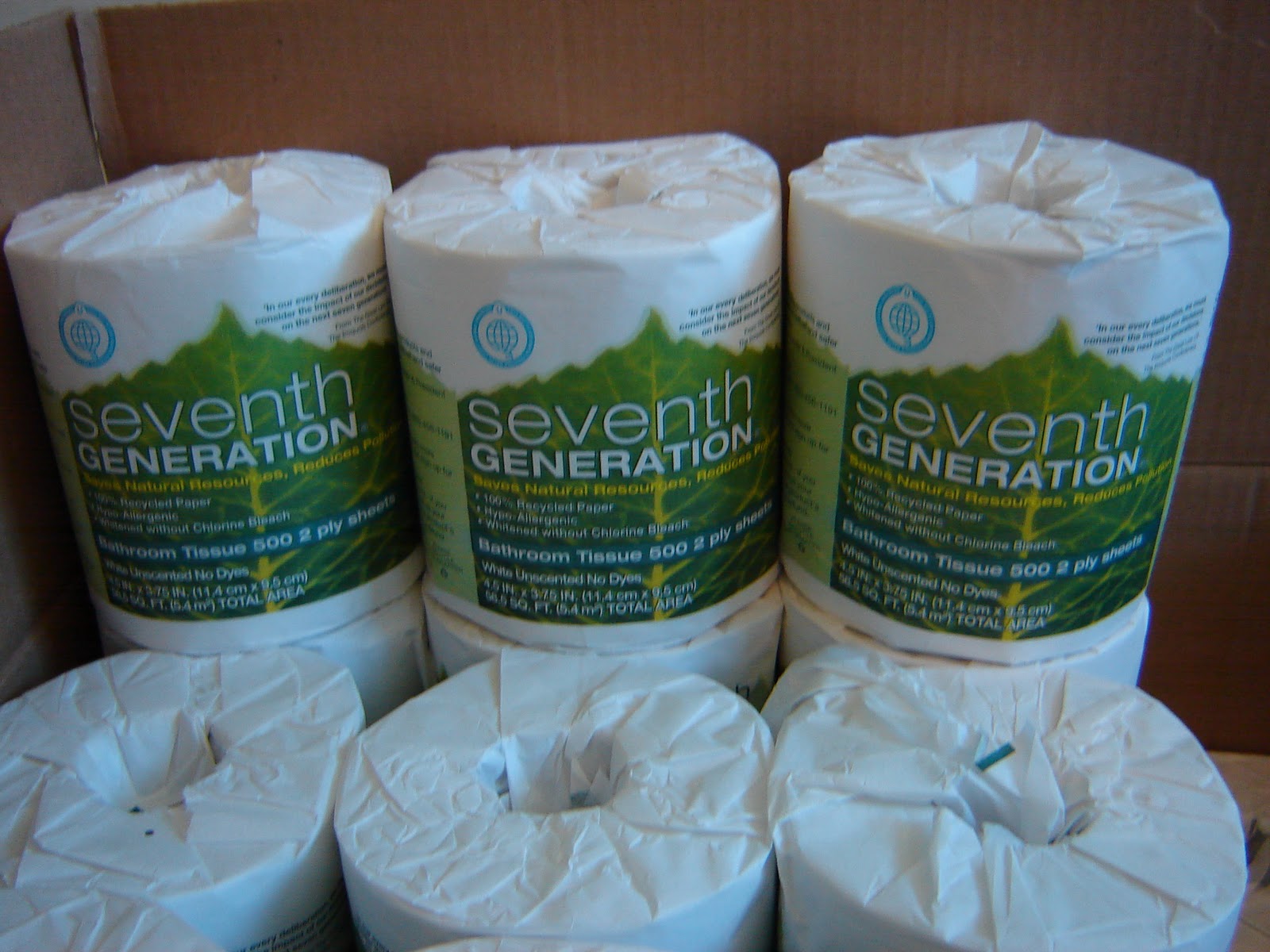
plastic ties or clamshells.

Our little bundles of TP joy
© L Kathryn Grace

There they are, our little toilet paper babies. I don't know about you, but sometimes living consciously takes a lot of effort. It's worth it, of course, and extra rewarding when we solve a problem we thought unsolvable. I get excited about every little victory, and this is one is especially sweet.

What about you? What small--or large--victories have you had in the realm of living mindfully this week? Conversely, what frustrations might you like to share? Perhaps you'll get lucky, as I did, and just the right person will see your quest and know how to solve it.

__
We make peace in a million small ways every day.
All text and images, unless otherwise noted, copyright L. Kathryn Grace. All rights reserved.

Tuesday, June 29, 2010

Societies without trash cans: How do they do it?

Seoul, Korea
© Stari4ek
CC NC ND 2.0
When our friend Claire returned from her first business trip to Seoul many years ago, she told us it was the cleanest city she had ever seen. Even the gutters and storm drains were free of trash.

What's more, when she looked for a waste bin to discard a used tissue, she could find none. There were no trash bins on the streets of Seoul.

Travel backward, to India's Ladakh in 1975, where linguist Helena Norberg-Hodge first met the farmers and villagers. She quickly discovered they reused everything. There were no trash bins, no garbage heaps.
Ladakhis traditionally have recycled everything. There is literally no waste. With only scarce resources at their disposal, farmers have managed to attain almost complete self-reliance, dependent on the outside world only for salt, tea, and a few metals for cooking utensils and tools.
Helena Norberg-Hodge
Ancient Futures, p.25

House in Ladakh
© Dr. Gebhard Gaukler
Creative Commons
The Ladakhi wasted nothing. Spent dishwater was fed to the animals for the small additional nourishment it could provide. Apricot pits were ground for their oil, and the remaining paste hardened into a tiny cup used in spinning yarn. Spent clothing, so worn it could no longer be mended, was soaked in mud and used to shore up irrigation canals.

Where we would consider something completely worn out, exhausted of all possible worth, and would throw it away, Ladakhis will find some further use for it. Nothing whatever is just discarded. What cannot be eaten can be fed to the animals; what cannot be used as fuel can fertilize the land.
Helena Norberg-Hodge
Ancient Futures, p.25

Animal and human waste were carefully collected, composted and distributed on the fields to nourish the soil. Plants we might consider weeds were harvested as surely as crops. Every part of every plant had a use.

Burtse is used for fuel and animal fodder; yagdzas, for the roofs of houses; the thorny tsermang, for building fences to keep animals out of fields and gardens; demok, as a red dye. Others are used for medicine, food, incense, and basket weaving.
Helena Norberg-Hodge
Ancient Futures, p.25


Zero waste is possible

The people of Seoul show us it is possible to live in a modern, busy city without ugly plastic bags, coffee cups, disposable water bottles and other trash cluttering their parks, streets and gutters. The people of Ladakh show us it is possible to live without generating any wasted material whatsoever.

Yesterday, we met the Green family, who are working toward zero waste in their lives. They've got it down to about 100g per week, which is a little more than two-tenths of a pound.

This thing is doable. We can build a society that wastes nothing. Of course, that means we have to stop wasting in our daily lives. When I think of the wasted food I toss every few weeks--uneaten leftovers, the cucumber that liquefied in the back of the veggie bin--I know I have a long way to go. As Mrs. Green said in a comment on yesterday's post, I need to take it one step at a time. I'll share our latest steps next week.

Meanwhile, I'm curious what you all think of this War on Garbage. I'd love to hear your thoughts.

__
We make peace in a million small ways every day.
All text and images, unless otherwise noted, copyright L. Kathryn Grace. All rights reserved.
Enhanced by Zemanta

Monday, June 28, 2010

War on Garbage: Shooting for zero waste

The Greens
Image courtesy The Greens of My Zero Waste
Zero what? On Earth Day 2010, when I declared a War on Garbage, my objective was to minimize our household contributions to the waste stream by the same date 2011. Shooting for zero waste hadn't occurred to me.

Guess what! Around the globe, ordinary people like you and me are working toward that very goal: Zero waste in their households. They're way ahead of me and offer dozens of tips and plenty of community support for living consciously and reducing the junk and trash in our lives.

Read what one family, the Greens in the United Kingdom, have to say about their zero waste adventure.
There were four key things that started us on our zero waste journey.
  1. Having a child raises your awareness of the fragility of the planet. You realise that long after you have gone, your children and their children still need somewhere safe and clean to live.
  2. We have been inspired by other people walking their talk on the internet such as Mrs Average from the Rubbish Diet, Tracey Smith from the Book of Rubbish ideas, Beth from Fake plastic fish, Jen from the clean bin project and a host of other people making real changes.
  3. Reading stories about the devastating effects of plastic on marine life and wildlife touched us beyond words. After seeing the impact of our lifestyle on innocent creatures we were compelled to take action.
  4. We were in Boscastle on the day of the flooding. Watching people’s cars and possessions being washed out to sea makes you realise that the impact of climate change is real and its happening right now.
Rethink your 'insignificance'

Responding to the oft-asked question, "How can my individual action make a difference," the Greens, have this to say.
We urge you to rethink your ‘insignificance’ and get on and make a change anyway. Once your friends and family see you making changes they might be inspired to join in. Before you know it you will be making a real difference.
There's nothing like good company on a long journey, and I am grateful for the Greens. There are many more individuals and families like them. I'll introduce you to them along the way. Perhaps you know a few yourself. I invite you to post a link to their web site and tell us what intrigues you about them.


Zero waste household--Not even close

Here in our little San Francisco apartment, we're taking our journey one piece of trash, one decision, one success, one failure, and one day at a time. Zero waste is a ways off, but we're learning from the Greens, from you, who show us what you're doing on your blogs and in comments here, and from so many others.

Building an Ordinary world is possible because of people like the Greens, who are doing it now, and because the Ladakh show us it's already been done. Tomorrow, we'll explore ways the Ladakh managed their waste for centuries--surprisingly simple.
__
 
We make peace in a million small ways every day.
All text and images, unless otherwise noted, copyright L. Kathryn Grace. All rights reserved.

Enhanced by Zemanta

Monday, June 21, 2010

War on Garbage skirmishes: Some wins, some losses

Losses this week:
Paper Towels, Food in plastic, beverage bottle
Image © L. Kathryn Grace
Sometimes my War on Garbage feels more like a sputter. We've had a few successes. The failures are the gold mines, though, because they point the way to next steps. Here's a recap of this week's wins, losses and challenges.
Win: Since declaring the war on garbage on April 22, we've emptied our 2.3 gallon kitchen trash bin twice. (We used to empty it at minimum once a week.) It's about three-quarters full right now. Sometimes a win is in what we didn't do!
Win: I've discovered a passel of recipes for making my own no-rinse shower cleaner, (That is a biggie!), hand and body lotion and much more. As I try them out, I'll report on their success (or not) here and provide links.
Loss: I left my filled water bottle sitting on the kitchen table when I rushed out the door for a weekend trip and was forced by need and thirst to buy a bottle of tea at the train station. Sure, I reused the bottle all weekend, but geesh! Water bottle. That's Reduce 101.
Loss: Our dear foster grand-kitty is ailing. At sixteen, and with a long-term kidney ailment, she's overdue for her final stage. This week we bowed to convenience and bought two rolls of non-recycled, extra absorbent paper towels to deal with the messes.
Loss--Maybe: After searching the web and my local green haunts, I've found not a single supplier of witch hazel in glass bottles. (See War on Garbage: Easy, inexpensive homemade skin toner cuts waste.) I'm holding out for one slim possibility--a small organic company whose sales staff have yet to respond to my inquiries.
Continuing challenges: Plastic bags and bathroom waste. We've cut back, but I still have to empty the bathroom trash a couple times a week, and I'm constantly amazed at the myriad ways plastic bags come into our lives. I've included a couple I'm not quite ready to ditch in the image above.

Slow and steady

We're taking our journey one piece of trash, one decision, one success, one failure, and one day at a time. We're learning from others who are living consciously and writing about it on the web and from you, who show us what you are doing on your blogs and in comments here. Leave one today, won't you? Not only are your experiences--successes and failures--important. They are valuable.

Looking forward, looking back

Tomorrow, I'll give you a taste of the pristine valleys of Ladakh and set the stage for exploring how the Ladakhi managed their waste for centuries--before we introduced our more-is-better, throw-away, tear-on-the-dotted-line values. Sometimes progress, and building a more Ordinary world, requires looking back and reclaiming the best of what we had before the industrial revolution.
Have a wonderful week, everyone!
__
 
We make peace in a million small ways every day.
All text and images, unless otherwise noted, copyright L. Kathryn Grace. All rights reserved.

Monday, June 14, 2010

War on Garbage: Easy, inexpensive homemade skin toner cuts waste

© L. Kathryn Grace
It was one of those calls, nearly two years ago. Family emergency. I grabbed a couple changes of clothes and made a quick inventory of my toiletries travel bag. Good. All bottles at least half full.

The visit lengthened from a few days to ten. Halfway through, I ran out of facial toner, borrowed a car and checked two stores close to the hospital. Neither had my brand. I have sensitive skin, and didn't need the hassle of an allergic reaction to an untested (on me) product, so I reverted to an old tried and true remedy: witch hazel. The 16 ounce bottle cost less than three dollars.

As a budget-conscious young woman, I used witch hazel for years without any problems to my skin or pocketbook. I never cared for the scent, and eventually "upgraded" to a more stylish toner at the glitzy department store makeup counter. At $27 a bottle, (sold in a lovely frosted glass container, mind you), the toner was as pretty on my bathroom counter top as it was pleasing to use. When I began to come to my senses, I switched to a less expensive drugstore brand, which by then I had been using for several years. Not finding it, I checked my old standby, and found it tucked down on the bottom shelf. Witch hazel would do just fine.


Essential oil yum

Back at the house, I filled my washed toner travel bottle with the witch hazel, added a couple drops of Tea Tree oil, which I already had in my travel kit, and voilà! Fresh toner. Adding a favorite essential oil to this mild astringent makes a delightfully refreshing concoction. You could use lavender, geranium, rose or any essential oil. I like the extra tingle I get from the Tea Tree oil. It doesn't hurt that it is known for skin-enhancing and bacteriological properties as well. Plus, the fragrance quickly dissipates, and I needn't worry that I am wafting allergens to friends, family and passersby.

There's more to love about witch hazel and essential oil as toner. I've benefited the following ways.


Buying less = lower carbon emissions

That first pint bottle of witch hazel lasted several months. Eventually, I purchased a second, 32 ounce bottle, which is nearly empty.

That's all to the good. Had I continued purchasing my old toner, over the same time period I'd have contributed carbon emissions through shipping several times. Using the witch hazel cut those emissions to just two shipments worth. I can't tell whether I saved plastic, as I recycled the old toner bottles long ago, but I would hope there is less plastic in a pint or quart bottle than in several 8 to 10 ounce bottles.


I'm saving $$

The low cost of this homemade toner is a boon. Here's the cost breakdown.

Tea Tree Oil: $3.99 for a 1/2 ounce bottle today
Witch Hazel: $6.99 for 16 ounce bottle today
Total today: $10.98

Compare that to several bottles of inexpensive, off-the-shelf drug store toner I used at the time. At nearly eight dollars per eight ounce bottle, they cost about a dollar an ounce.

Remember, I already owned the Tea Tree oil, and had used some. Very likely the $3.99 cost today is an increase over two-plus years ago. I no longer have the receipt for the witch hazel, but I remember being pleased to see it cost less than $3. So it has more than doubled in price. In fact, the 32 ounce bottle I bought last time cost $6.99, exactly the same price they're charging for 16 ounces today. The clerk told me they no longer carry the 32 ounce size.

That's okay, because I'm looking for organic witch hazel in glass this time, and I'm willing to pay more to nourish the soil, preserve the multi-crop woods in which the plants grow wild, and assure the farmers and their employees earn a fair living.


This week's War on Garbage mission

Find witch hazel in glass bottles. I've searched the web and called both local and distant suppliers with no luck so far, organic or not. If I don't find it in glass soon, I'll be forced to buy plastic again. Yuk!

If you know of a source for witch hazel in glass, please contact me! (You can reach me at graceonline at sbcglobal.net)

Buy organic. Not because it will change my waste stream significantly, but because it is part of my larger mission to live consciously and do as little harm as possible. Conventional harvesters, according to Organic Witch Hazel, cut every stem to the ground. They take everything, down to the smallest twig and stem. Organic producers harvest sustainably, taking a small percentage of the overall plant, its leaves, new growth, flowers and fruit.

The witch hazel bush (Hamamelis virginiana) grows wild in many parts of the country. Some organic farmers gather wild witch hazel by hand in their multi-use forests so as not to overly-stress the eco-system (good for the planet), and they pick only at peak times for highest phyto-chemical content and most oil production (good for us).


Learn more about this ancient, healing herb

For more information about this old-fashioned plant and its many uses, check this Wise Bread page.


What's your story this week?

What is your eco-focus this week? What small change are you making in your life to build a more sustainable, healthier world for our children and grandchildren, a world more like the Village of Ordinary?


Disclaimer: I'm not an herbalist or cosmetologist. I am merely a consumer who has found this product useful in my personal care regimen.

__


We make peace in a million small ways every day.


All text and images, unless otherwise noted, copyright L. Kathryn Grace. All rights reserved.

Monday, June 7, 2010

War on Garbage: The personal is political

Image copyright
cesarharada.com
Creative Commons license
We're in the kitchen, three of us. He's fixing a sandwich to gobble on his way upstairs to an important phone call.

She's fixing snacks for the little ones before we rush out the door to pick up the oldest.

I'm fixing to ride along and catch a train.

Bustling and bubbling with news, ideas, catch-up, there's no time to sit down and get to the heart of things. We're jabbering on the fly. The topic is plastics. Conversation goes something like this.

He: "I think you're wasting a lot of energy eliminating plastics from your life when the problem is so much bigger."

She: "Yes. The problem is bigger than you. Why don't you work on changing how plastics are recycled? Make it easier for all of us to recycle all our plastics? That would have a bigger impact."

Me: "Yes, recycling is critical, but it's a stop-gap, not the solution. Polymers are getting into us, into the kids. I have to do what I can to limit their exposure, our exposure. And what about all those poor sea creatures swallowing so much plastic they suffocate and die? (Call me a bleeding heart.) No matter how much I recycle, I can't be sure some of my plastic crap won't end up choking a giant sea turtle, or floating in the great Pacific gyre."


Not exactly a 30-second elevator speech

Boy, do I wish I had already perfected my thirty-second elevator Why-I'm-Pitching-Plastic speech. It would go something like this.

Giving up plastics is something like giving up cigarettes. Many of us stopped smoking a long time ago. We didn't want a slow, suffocating death. A lot of the PCBs, BPAs and phthalates circulating in our bodies, in our children's bodies, in every mother's breast milk, will never leave us. No one knows what slow, agonizing deaths we may be generating. There are pointers, but too few studies tell us anything for sure. Why take the chance? We need to stop ingesting them. To do that, we need to stop bringing them into our environment.

It makes no difference whether we're manufacturing or re-manufacturing plastic, we're putting toxic polymers and their relatives into the atmosphere, into the water, into the ground, and yes, into our bodies.

Of course, that's not the whole story. Plastic is made from fossil fuels and, it bears repeating, very difficult to recycle. Sure we can make it from corn and soybeans. On a planet of 6.8 billion people (more than double the 1959 total of 3 billion), and expected to increase to 9 billion before mid-century, which is more important: crops for food, or crops for plastic and profit?

I get that plastic is endemic. I get that I can't escape it. Shoot, I'm having a heck of a time simply slowing down my use of plastics, let alone eliminating them. Still. I absolutely have to take responsibility for my part of the problem.

So I'm doing something about it, personally and politically. When I slow the flow of plastic items into our home, when I choose plastic-free alternatives, I vote.


S-u-p-p-o-r-t
(To the tune of D-i-v-o-r-c-e)

One vote doesn't make much difference, but it is part of my personal goal to live consciously, and by writing about it here, I lend support to all the others reducing their plastic consumption. As more and more of us talk about what we're doing, we learn how many others are voting with their dollars, how many are writing letters to manufacturers, city officials, legislators and senators asking for change.

We connect. We learn from each other. We discover we're not alone, we're not an insignificant voice, and we are growing in numbers.


Worth my time, how about yours?

We have to stop bringing so much plastic into our environment, our homes and our bodies.

That's why reducing the plastic in my life is worth my energy, worth my time and is a political act. Yes, I will continue to work toward better and better recycling options, but what I do--or not--with plastics every single day counts.

What you do counts, too. It's our collective actions and choices that got us into this mess. We are the ones who can get us out. There's no denying plastic raises a lot of tough issues. What do you think are the best ways to solve the problem? Do you (will you) vote with your dollars and demand plastic-free alternatives wherever possible?

The more we vote with our dollars on the plastic issue, the sooner viable solutions will become profitable and real, and the closer we get to a world a whole lot more like the Village of Ordinary.

__
We make peace in a million small ways every day.
All text and images, unless otherwise noted, copyright L. Kathryn Grace. All rights reserved.
 

Enhanced by Zemanta

Monday, May 31, 2010

War on Garbage: It's the little things

Stored plastic tubs
Stored takeout containers
© L. Kathryn Grace
It never ceases to amaze me how much throw-away junk we bring into the house. True, we're cutting back. Because of our war on garbage, we're thinking more than ever before we purchase. Still.

Last night, neither of us felt like cooking. We don't order in much any more, but we made that choice. Two more plastic hot food containers to add to our collection. We find all sorts of uses for them. You can just make out one example on the bottom shelf in the image above, but we always have three stacks in the cupboard. Eventually, one way and another, one by one, they'll chip, crack, become irremediably filled with paint or homemade Play-Dough residue and end up in the recycling bin. Fail!

Friday night, we had the grandbaby over. She's two now, and we took her to the neighborhood restaurant for pizza. We like this place because they use organic ingredients whenever they can get them, and they're kid-friendly. We bought two small pizzas. I know, I know, but we don't like the same toppings or sauces. We like leftovers. We never know which pizza the little one will choose. Then, because I forgot to bring foil and a bag to wrap and carry the leftovers home, we ended up with two take-home boxes. I would have crammed it all into one box, but again I neglected to tell the wait staff, and they brought back two. Fail!


But wait! There's good news!

Do compost poster
Do compost poster
Courtesy Recology SF
First: I've been doing some research and learned that San Francisco's compost program includes a whole lot of stuff I was tossing in the trash. We can send those pizza boxes and the wax paper liners in their bottoms to the compost, along with waxy milk cartons, butter boxes, and much of our bathroom tissue waste (the dry stuff, that goes in the waste basket anyway). Why they even take cat hair!* Better.

Second: It's been three weeks plus since we last tied off and emptied the bag in the small kitchen trash can. Thanks mostly to living in this city, with its zero waste goal, today the bin has plenty of head room for more trash. That's 2.3 gallons of landfill waste--once a week just one month ago--pared down to once in three weeks and counting. Big win!

Third: Our commitment to buying only in bulk when available is paying off, but not perfectly--yet. No new cereal boxes or sugar containers have come into the house. One of us bought a couple of boxes of Annie's organic macaroni and cheese--a favorite of the grandkids when they visit. It doesn't take that much longer to make homemade, which we like so much better, so we need to make an adjustment. Better, but plenty of room to improve.

Fourth, and this is the most fun: With fruit season in full swing, I bought a half flat of strawberries from our local farmer's market and made jam for the first time in decades. The berries that tasted best that day, Chandler, were expensive, $5/quart, and by the time I boiled the fruit down to make jam with no added pectin, the eight-ounce jars cost about $5.79 each. My labor was not factored in, so true cost is even higher. Coincidentally, the 12-ounce jar of imported organic jam in our refrigerator has a $5.79 sticker. (Why is it so difficult to get organic jam made locally?)

Jar of strawberry jam
$5.79 jar of strawberry jam
© L. Kathryn Grace
Now I know why the organic jam and jelly purveyor (Blue Chair--snap some if you live here and get the chance) at the same farmer's market is charging $11 for a 6-ounce jar! Homemade is not exactly a bargain. Perhaps I can improve the net cost of raw ingredients by more judicious shopping. Meanwhile, we avoided overseas shipping. One upside.

Then there's the really big downside. To cut costs, and ostensibly keep prices down, Ball (who absorbed Kerr, so there's no longer competition) now shrink-wraps its partially-boxed jars. We gave away our canning jars years ago, and had to buy new. Sure, I could have tried to find them on Craigslist or Freecycle, but I would not know how they had been handled. Our food safety and health depend on jars that have been handled carefully, so we bought new. We'll take good care of them and use them many times over. Meanwhile, I've written the Ball people and asked them to return to boxing without plastic. If you have the time, I encourage you to lend your voice to mine. I'm sure we're not alone in this request.

Not to despair. There is another upside to making our own jam: Every time we open a jar, we will be omitting a made-for-single-use, shipped and re-shipped jar and lid from our recycling bin. Sure, we use the jars again, but they pile up quickly, and we don't have the storage space for a lot of jars that are not of canning quality. Too many go to recycling. I'm calling this one a partial win.

That's the story on the war on garbage this week. A few steps forward, a few back, but making progress on the road to conscious living.

*UPDATE 6/1/10: Sadly, I was mistaken about the cat hair.


What are you up to on the eco-front?

What's your story this week? How are you handling your waste challenges? If you have a garden, I'd love to hear what's up, what's ripe, what tastes fabulous, and just maybe, what you're preserving and how.

__
We make peace in a million small ways every day.
All text and images, unless otherwise noted, copyright L. Kathryn Grace. All rights reserved.

Monday, May 24, 2010

War on Garbage: Fake Plastic Fish Challenge

 
Miscellaneous discarded plastic items lined up on forest green cloth
Household plastic waste--Week 1
© L. Kathryn Grace
Last Monday, in my ongoing war on garbage, I was spittin' plastic after watching the video, Our Today is Forever. It was time to commit to the Fake Plastic Fish Challenge.

What you see in this image is just one week's worth of plastic throw-aways for our household, twenty-nine items in total, only nine of which are recyclable. The remaining twenty had to be pitched.

Fake Plastic Fish asked for some data, and I'll share with you what I told them. (It's mostly verbatim, but I edited slightly in a few spots for clarity here. The questions are theirs.)


Personal description

Who: A cat and two humans, one full-time employed, the other semi-retired; frequently graced with the presence of grandchildren.

Where: San Francisco.

Biggest plastic challenges: 1) Keeping the cat well fed, healthy and her litter box clean without plastic--not happening, yet; 2) Resisting the urge to buy shiny, plastic-wrapped, plastic toys for the grandkids.

Biggest plastic boon: Monster city-wide curbside recycling program with few restrictions. Most of our plastics are trucked to the front door of the city's multi-million dollar recycling center, where they are sorted on a giant Rube Goldberg conveyor belt system, then baled and funneled out the back door onto ships that head for China and the Pacific Rim. We can only hope that mountains of plastics are not sitting in someone's back yard, as we saw in The Story of Bottled Water (video). For more on that, see Would you pay $10,000 for a sandwich?


Total weight of plastic stash

Approximately 13.5 ounces (I had to estimate the weight of the kitty litter bag as it is filled with clean litter. For sanitary reasons, I discarded the empty one early last week as I had used it for dirty kitty litter when I changed the box.)


List of Recyclable Items
Include the recycling # at the bottom and how it gets recycled in your community, as far as you know.

1. Strawberry clamshell - #1
2. Medjool date clamshell - #1
3. Shampoo bottle - #2
4. Pill bottle - #2
5. Medicine bottle (for grandbaby) - #2
6, 7, 8 & 9: Individual apple sauce containers - #5

San Francisco accepts all firm plastics--the ones with the recycle symbol on the bottom--that are clean of metal, fabric and rubber. They do not accept plastic bags, shrink-wrap, bubble wrap, or filmy plastics like Saran Wrap. Most of the recyclable plastics are loaded on ships for China or countries in the Pacific Rim where they are made into new products and likely shipped back to us, all glossy and encased in--you got it--more plastic.


List of non-recyclable items

1 & 2. Toilet tissue packages
3. Frozen blueberry bag
4. Kitty litter bag
5. Trash bag (Partially filled with household non-plastic, non-recyclables, non-compostables and the day's kitty litter gleanings)
6 & 7. Intimate product liners
8. Toy package bubble
9. Brown sugar sack
10. Godiva shipping cold pack bag
11 & 12. Cheese packages
13. Tortilla package
14. Toy package bubble
15 & 16. Cat medicine tablet holders
17. Toy package
18 & 19. Cut corners from kitty litter bag & tortilla bag
20. Toothbrush package


Tally analysis
(Answers to the following questions)

What items could I easily replace with plastic-free or less plastic alternatives?

 1. The strawberry container and the blueberry sack are easy to eliminate by buying fruits only in season at the farmer's market and carrying them home in our own reusable containers.
2. The individual apple sauce containers are an aberration at our house and unlikely to be in our recyclables again. Typically, we buy applesauce in glass jars, but now that I am semi-retired, I hope to make homemade.
3. The plastic trash bags are being phased out in favor of compostable bags. While they will not break down in the landfill, they will biodegrade quickly should they be released into the environment.

Possibles:

1. Shampoo bottle: One of us still uses commercial shampoo. The other (me) switched to no-poo awhile back, which means I'm bringing no new shampoo/conditioner bottles into the house. My sweetie is undecided, but strongly considering trying no-poo.

2. Intimate product liner: I am searching for intimate products without plastic liners and have purchased a few organic cotton ones for trial.

3. Medjool date container: We are looking for a bulk source of organic dates where we can fill our own reusable container. These are an important part of our diet, so an alternative absolutely must be found.

4. Toy packaging: We're grandparents. Sometimes we can't resist buying cutesy toys on a whim. Wherever possible, we plan and choose sustainable wooden and handcrafted toys for our grandchildren, but they are usually encased in shrink-wrap or nearly impenetrable plastic bubbles. Plastic seems inevitable in toyland. We can do more to reduce, however, and will continue to work on it.


What items would I be willing to give up if a plastic-free alternative doesn’t exist?

1.  Brown sugar sack: While we can buy organic raw sugar in bulk, we have not yet sourced brown sugar in bulk, but we keep looking. I am researching ways to add molasses to recipes in lieu of brown sugar.

2. Tortilla and other wrap packages: Again, because I am semi-retired and have more time, I am looking into recipes for homemade tortillas and other wraps so we can avoid those packages. This would not be possible if I were still working 50-60 hour weeks.


What items are essential and seem to have no plastic-free alternative?

1. Toilet tissue packages: I'm constantly trying to think of ways to minimize and ultimately replace. Write your suppliers and ask them to package in recycled paper!

2. Pill bottles: Alas, necessary, and again, write the suppliers! The more who write requesting glass bottles, the more chance we'll have of achieving change.

3. Medicine bottle for granddaughter: We have to keep a supply of this doctor-prescribed over-the-counter brand on hand for her overnight visits, and no other packaging is available.

4. Godiva ice-pack shipping bag: Not essential, but it came in a gift package, and I am unlikely to dictate to friends and family what they may or may not choose as gifts. I will, however, continue to show my preferences by example, through my writing, which some of them read, and through topical discussion. We keep such items in the freezer and reuse, but I have four of them now, and this one had to go to make room for fresh-frozen foods from the farmer's market. Just realized I could have advertised it on Freecycle. Duh!

5. Cat medicine tabs: We cannot source any other method for the cat's life-saving medicine.

6. Kitty litter bag: We buy the most ecological we know of, but I must write the manufacture regarding packaging.

7. Toothbrush packaging: So far, I have found no toothbrush packages that do not involve plastic.

8. Frozen berry (and vegetable) packaging: While I will source fresh farmer's market fruits and vegetables  wherever possible, it is likely we will continue to use frozen berries and some vegetables in winter months. Eliminating these from our freezer is a long-term goal and will require changing our expectations of what we should have available to eat on a moment's notice. This will take gradual, habit-changing practices.


What lifestyle change(s) might be necessary to reduce my plastic consumption?

I already made one that has made a huge difference: Partial retirement. Had I not semi-retired in the last year, we would have a much larger plastic problem. Like many people, I worked 50-60 hour weeks and all too often opted for quicker, easier solutions. With more time available, I can assure I get to the farmer's market every week, where I can purchase the freshest whole foods and carry them home in my own reusable containers.

I also have time to relearn old skills, such as breadmaking, and to experiment making foods that I previously bought in packages during the years I worked outside the home. These included bread, tortillas, wraps, jams and jellies, frozen fruits and vegetables, sometimes soups and beans.

The biggest lifestyle change would require a move to an apartment or home large enough to accommodate a deep freeze capable of preserving large quantities for up to a year without significant loss of flavor or nutrients. Such a change is unlikely in the foreseeable future.

My dream lifestyle change is to live and work in an ecologically conscious community with communal kitchens and gardens where we could share some, but not all, food growing, gathering, preserving, preparing and eating. I vision and write about such a community in the fictional Village of Ordinary and here.

Until this or something better is possible in our lives, we will continue on our current path of gradually reducing plastic consumption, one awareness, one problem-solving moment after another.


What one plastic item am I willing to give up or replace this week?

We have purchased compostable trash bags, which we will use for non-compostables/non-recyclables, including kitty litter. We won't start using them this week though, because we still have a stash of the regular plastic bags. I know of no ecological benefit to throwing the unused bags still on our shelf in the trash.


What other conclusions, if any, can I draw?

We need to re-grow our society from the ground up. Ours is a tear-on-the-dotted-line, disposable, throw-away, consumption-addicted culture. We as individuals are the only ones who can change that, by voting with our dollars, asking manufacturers to change, and spreading the word about the need for systemic change until the movement for making conscious, life-enhancing, Earth-preserving choices has reached critical mass.

__

Much gratitude to Beth Terry, who writes Fake Plastic Fish and issued the challenge. She is doing a grand service to us all by founding and maintaining her blog, keeping the message out there on numerous social networks, and running the challenge.

Much gratitude to you, as well, my few (so far) and faithful readers, whom I treasure, because I am aware that several of you are way ahead of me on this journey to conscious, mindful living. How do you manage the plastics in your life? Are you interested in taking the challenge? Have you already?

__

We make peace in a million small ways every day.

All text and images, unless otherwise noted, copyright L. Kathryn Grace.
All rights reserved.

Monday, May 17, 2010

War on Garbage: Spittin' out plastic

Typical garbage bin at our house
© L. Kathryn Grace
One hundred million tons of plastic. That's how much is estimated to be floating in the great Pacific garbage patch, now bigger than Texas.

Ocean faring birds eat it till their bodies, unable to pass the stuff, burst. Three hundred year old giant sea turtles get entangled in plastic ropes and wash ashore strangled. Bad, bad news, and we're the culprits. I don't want to be one of them any more.

On Earth Day, when I first declared war on garbage, a whole lot of plastic was visible in my trash can--including the disposable liner! None of it is recyclable. Of course we hope our plastic and other non-recyclable, non-compostable trash is buried in the landfill, where presumably it can do no harm.

You believe that, right? Once in the landfill, our trash, even our plastics can do no harm? Yet, sadly, somehow our plastic throwaways end up in our rivers and oceans where fish, giant sea turtles, pelicans and other sea birds get tangled in it, eat it, and die. Take a look.


Thanks to @pauljimerson, from whom I first saw the video when he retweeted @DianeN56and @PlasticPollutes, who discovered the video by @Plomomedia. (It takes a village.)


Holy crap, Batman, plastic is forever!

Is it? Science has discovered that some plastics break down in the ocean. That sounds like good news. Not so fast. According to Carolyn Barry of National Geographic News, science also found that these disintegrating plastics are "leaching potentially toxic chemicals such as bisphenol A into the seas, possibly threatening ocean animals, and us."

We're the last stop on the food chain--whales in the sea, people on land. We get all that accumulated BPA and who knows what other toxins unraveling from those slippery polymers. What will it do to life on this planet? What will it do to our children? And theirs?


Taking the Fake Plastic Fish challenge

So this week, the Grace household is tackling plastic. First step: We're taking the Fake Plastic Fish Challenge. Instead of tossing that berry container into the recycling bin or that empty frozen peas bag into the trash, we're going to set them all aside in a separate container. Next Monday, I'll lay them out and take a photograph of our collected plastics and post a writeup on the Fake Plastic Fish web site. We've been cutting back on plastics for awhile now, so it will be interesting to see how much we gather.

I'd love some company on this challenge. Will you join me? If you're interested, and can spare the time, be sure to check out the rules first. There aren't too many. Do let me know in the comments below whether you plan on participating. Either way, I'd like to hear about your relationship to plastic and what you think we can do to solve these problems.

__
We make peace in a million small ways every day.
All text and images, unless otherwise noted, copyright L. Kathryn Grace. All rights reserved.

Monday, May 10, 2010

War on garbage: Pitching paper towels

Open bag of trash
Waste basket collection
© L. Kathryn Grace
Ugh! Remember this from my Earth Day declaration of war on household garbage? This lot was collected from the small baskets sitting about the house, much of it bathroom waste--paper towels and tissues. I collect almost two pounds of this stuff every week.

Most of the paper towels in this mess have to do, one way and another, with hair. Cat hair. Wads and wads of the stuff.


Urrrk

My sweetie and I are a tad squeamish. There's something about unattached fur that sends us both in a tizzy. When our dear Salome sheds, it's not veils. It's fur balls--tufts and tufts and tufts of Persian longhair. What do we do? Grab a paper towel, wet it slightly, engulf those flighty tufts, one after another, and toss 'em in the can. Five minutes later, do it all over again.

Occasionally Salome leaves us a nice fat hair ball nestled in a slimy puddle. Urrrk. That's the sound we make when we pick it up, carefully covering it first with a paper towel, grabbing the whole mess with another. Involuntary muscle spasms. Urrrk.

That's not all. Cat hair flies, and what flies has to land. Everywhere. I chase hair gingerly, with a damp paper towel, in the futile hope of grabbing it before it sails up and away again. Our tiny bathroom, a favorite Salome nesting spot, is constantly alight with fur. Two or three times a day, I run a damp paper towel around the bathroom fixtures, on the sills, in the corners, everywhere the fur settles. Salome especially likes to nap in the tub, so that gets a swipe too.

Then there's the kitchen. It's not all cat hair, of course. There will be spills. It's so easy to tear off a paper towel and wipe up the trail of slime from the avocado slice that shot from my hand, skipped across the butcher block like a stone on water and landed, smoosh, on the floor I mopped this morning. Or last month. While I'm wiping that up, I catch as much fur as I can reach.


Egg on the floor

How did it come to this? As a young mom, I refused to have paper towels in the house. Wasteful! Somewhere along the line, a roll came into our life. I suppose I eyed it gingerly at first, but then there was that egg that rolled off the counter top and splatted all over the indoor/outdoor carpet tiles (Why would anyone put indoor/outdoor on a kitchen floor?) and halfway up the cupboard doors. That roll came in handy, too, when my three year old poured, and immediately dumped, a brimming glass of milk. It wasn't long before paper towels were a mainstay.

Fast forward. Kids grown up. Many life changes. New mate, just the two of us for decades now, and here we are, until recently using at least one roll of paper towels a week. At $2.99 a pop, that adds up to $155.48 a year, plus tax. Now I know $150 doesn't go far these days (Astonishing!), but it's the principle, I say! The price of convenience, you say?

Not this year. I'm at war with my throw-away habits.


Here's what I'm doing about it


Reusable cloths cost about the same as a roll of paper towels
© L. Kathryn Grace
A couple of weeks ago we bought several new dishcloths to augment our aging and increasingly ragged supply. Serendipitously, they were $2.99 each. Knowing what I do about conventional cotton production (here's just one example), I was compelled to buy organic. Now I ask you, if I'm willing to throw away $2.99 worth of paper towels a week, how can I flinch at paying the same price for organic cotton I can use again and again and whose manufacture is harming no one?

Reusable cloths in basket
No more disposables!
We're also trying out a couple of reusable clothsmade of recycled fibers. We keep them all in a handy basket on the kitchen work table, ready to grab and mop up spills or wipe our hands as we chop, dice and slice.

For the cat hair and every day floor messes, I cut an old, ragged bath towel to hand-sized squares. They're perfect for those quick swipes around the fixtures and to mop up spilled kitty water or to clean the floor boards.

Downside: I have to rinse those hair-covered cloths and hang 'em to dry. Do you know what wet black cat hair on a white cloth looks like? And the sink! Urrrk.


Success!

That was two weeks ago. So far, this change is a big success, better than any of the previous times we've tried to cut back on disposables. After two weeks, nearly an entire unused roll sits on top of the refrigerator, accessible, but no longer convenient. That helped. More importantly, this time, we brought the reusables to the work table, instead of storing them in a drawer. They're every bit as handy as the roll of paper towels had been. The floor rags are stored in a bin convenient to the kitty food and water bowls, where the most spills occur.

Making conscious choices is sometimes as simple as changing an outdated habit, but mindful living can be complicated. One concern about switching to reusables was that we might significantly increase our laundry and water use. That would do nothing to help us lower our ecological footprint. Fortunately, despite liberal use of the reusable cloths, I'll wash kitchen linens for the first time this weekend, and we have yet to accumulate a full load of floor rags. No problem.

__

Update: Buying in bulk
Update on my goal to buy in bulk (See War on Garbage: What is all that junk anyway?): I told you I'd get back to you on whether my sweetie would join me in avoiding pre-packaged foods and commit to buying everything available in bulk at our local organic grocer. The answer: A resounding yes and a new spreadsheet listing all the items we buy prepackaged, complete with suggested solutions for finding even more items in bulk. Tee hee. I'm so excited! We are making progress in the first and most important of the three Rs: Reduce, reuse, recycle.

What about you? What conscious choices are you making this week to help us all live in a world more like the Village of Ordinary?

__

We make peace in a million small ways every day.
All text and images, unless otherwise noted, copyright L. Kathryn Grace. All rights reserved.

Monday, May 3, 2010

War on Garbage: What is all that junk, anyway?


One week's waste accumulation
© L. Kathryn Grace
The first step in my personal war on garbage is to figure out what it is we're pitching. You can get a pretty good idea here.


There's a lot of paper, a lot of thin cardboard--the kind that cereal comes in and paper towels are rolled on, the occasional can or bottle, and lots of bits of plastic. Right on top, you can see the bag that held the frozen peas we had with our dinner last night.

First off, I should tell you, we've been reducing our waste contribution for some time. Just five years ago, we filled a 10-1/2 gallon trash canSimple Human Trash Canalmost every week, in addition to stuffing the recycling basket. Back then, we curb-cycled the large trash can (it disappeared in minutes) and acquired the 2.3 gallon version shown above, which we empty once a week. So in that time frame, we've reduced our landfill contribution by a minimum of 8.2 gallons per week. That's the good news.

But how can we reduce our throwaways and recyclables even more?


Stop the junk mail

First on the agenda: Stop the junk mail. We got rid of almost all of it a few years ago, but somehow we've managed to get on a whole lot of lists again, despite always hitting the opt-out button whenever we donate to a worthy cause or subscribe online.

In the last several weeks, my sweetie and I have been calling the businesses, non-profits and political organizations that send us junk mail and telling them to stop. Most are polite, take down our information, and assure us they will remove our names from their mailing lists. The credit card companies are the most difficult to deal with. After listening to seemingly endless menu choices, and pressing numerous buttons between, sometimes we end up back where we started. You know how that goes. Eventually, we get through to a human who claims they will take us off their list. In every case, the live reps tell us it will be six to ten weeks before we stop seeing their mailings. For some of those organizations, that's one or more fat envelopes every single week.

I'll let you know in a couple of months how well this worked.


Buy in bulk--Take reusable containers

Second step: Decide right now we're not going to buy anything in a box, can or plastic bag we can buy in bulk at the organic grocer a few blocks away. And we'll take our own reusable containers to hold the goods. That will eliminate most of those flattened food boxes and some of the plastic bags. We already buy most of our cereal, grains, nuts, and other dry foods in bulk at our local organic grocer. The problem is, all too frequently, when we're out of an item and in a hurry, we will stop at our corner grocery and bring home a box of cereal or a plastic bag of rice. The cereal boxes can be recycled, of course, but those plastic bags that hold rice, pasta and frozen vegetables cannot.

This will take a concerted effort. I need to talk to my sweetie about that and see if I can get a commitment. I'll let you know how that goes, too.

That's two good steps to move us further down the track. I'm working on a third today and will tell you more about that in the next post.

We're a long way, in our household, from the model of Ordinary, where nothing is wasted. The fictional people of Ordinary, like the very real people of Ladakh, waste absolutely nothing. Perhaps things have changed today, with the influence of Western culture, but when Helena Norberg-Hodge first visited the Ladakh in the 70s, there were no landfills, no unsightly dumps.

No ugly geometry had been imposed on this land, no repetitive lines. Everything was easy to the eye, calming to the soul.


This is the goal. Can you see it? Can you visualize a world in which we all care so tenderly for the earth and each other that we waste nothing, that everything we see is easy to the eye, calming to the soul?

__
We make peace in a million small ways every day.

All text and images, unless otherwise noted, copyright L. Kathryn Grace. All rights reserved.
Enhanced by Zemanta